
Keep the module, source and context of every signal intact.
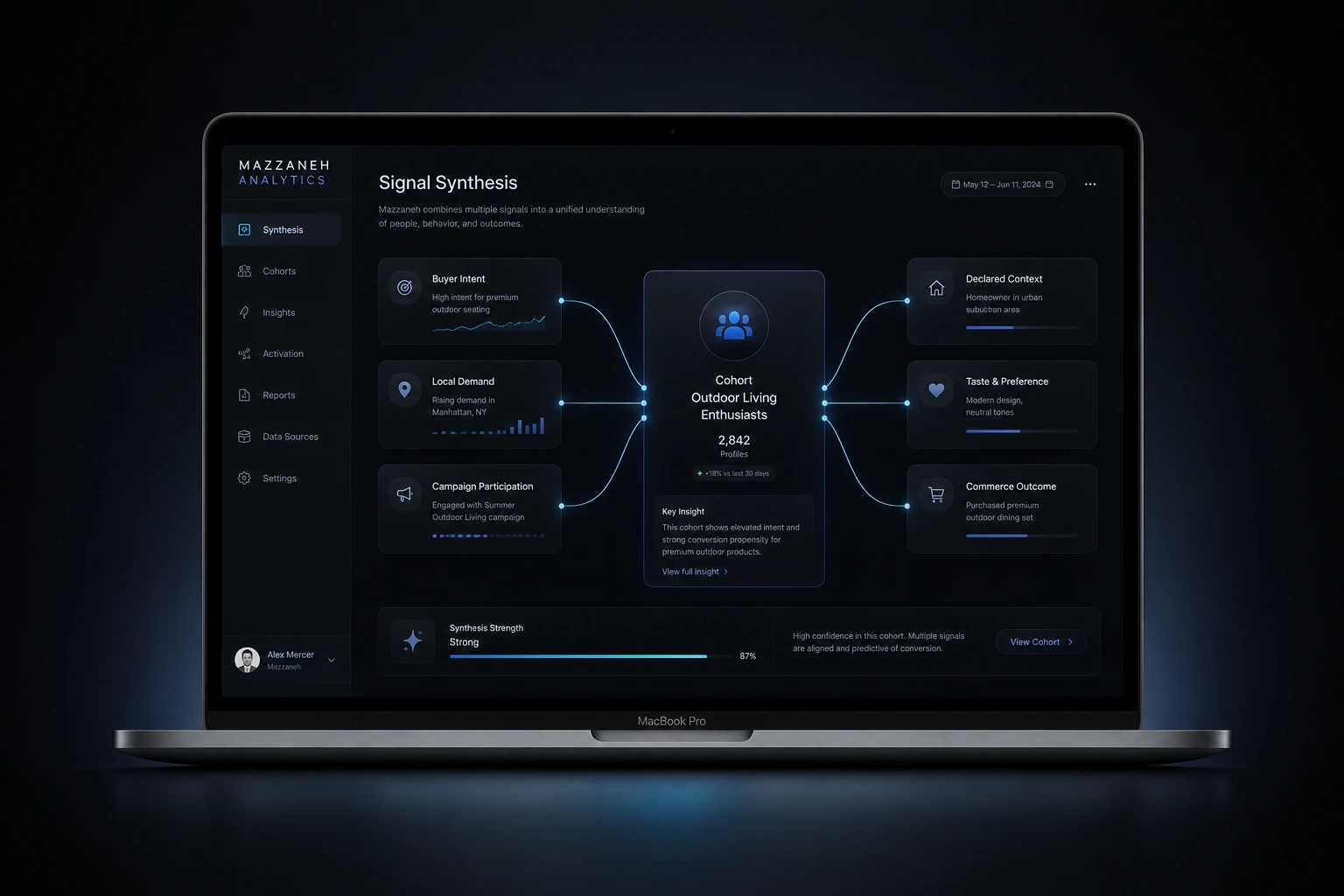
Intelligence layer · Analytics
One signal rarely explains the customer. The pattern between signals can.
Mazzaneh created different forms of context across commerce, participation and preference. Analytics combines those signals so a business can understand not only what happened, but why the pattern may matter.
Why it had to exist
A click does not necessarily mean preference. A request is not a purchase. A correct Board answer is not identity or expertise. Isolated events could count activity but could not safely explain the customer.
Primary job
Preserve signal provenance and confidence, then turn cross-module patterns into testable business hypotheses.
Historical and later architecture sources support a synthesis layer. Exact production maturity, model performance and signal-by-signal implementation require evidence review.
Core mechanism
From friction to a usable product flow.
Distinguish declared, qualified, behaviorally reinforced and outcome-confirmed states.
Inspect consistency and contradiction across products, cohorts and time.
Translate patterns into a testable decision and measure the next outcome.
Signal library
Do not ask one event to explain the user.
Combine independent evidence types while preserving what each can—and cannot—mean.
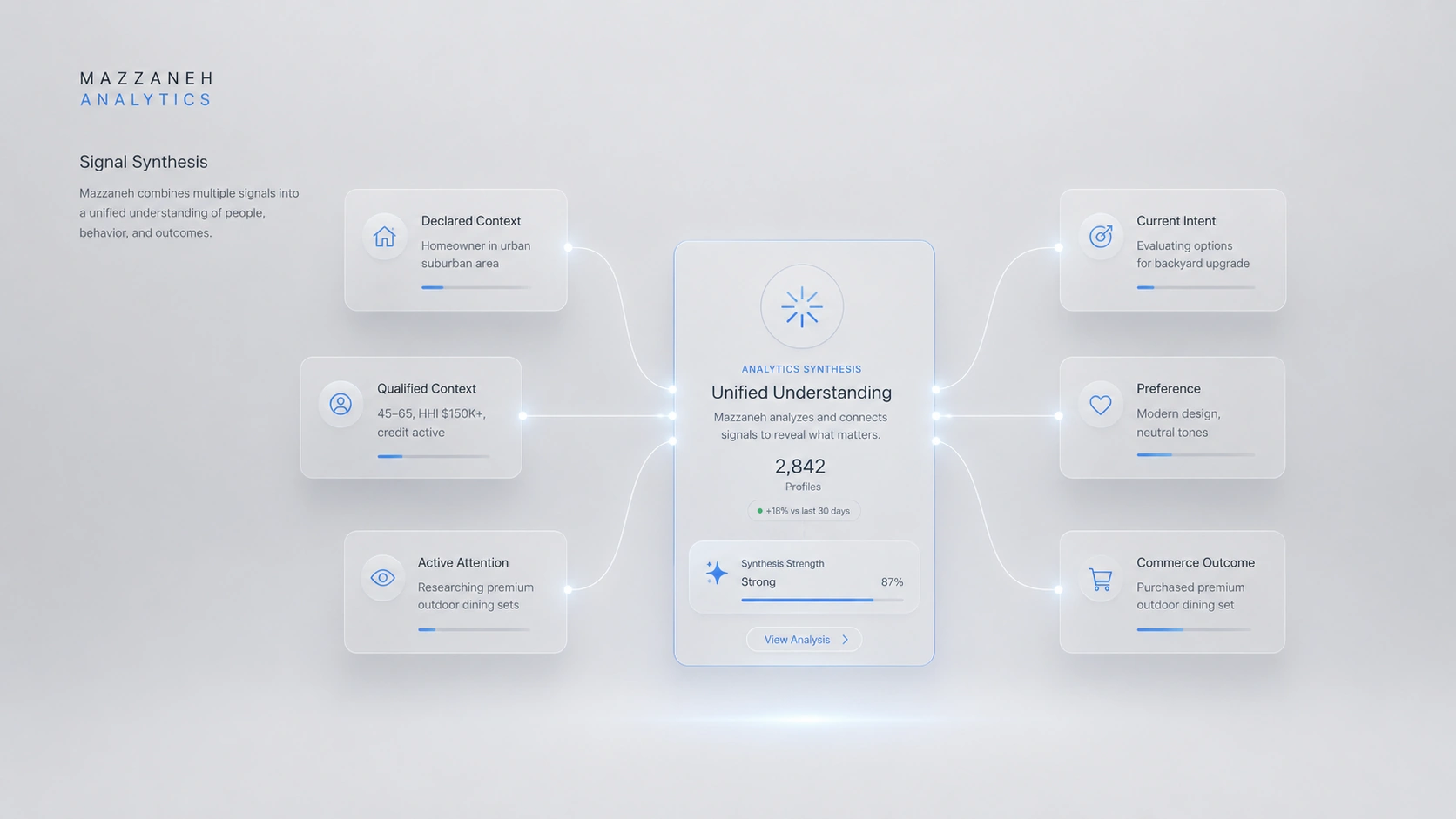
Declared context
Work, interests, skills and tastes provide explicit self-description. Useful context, not automatic truth.
Qualified context
Eligibility, identity checks and later behavior can strengthen or challenge selected declarations where the mechanism exists.
Active attention
Board product learning and questions create a stronger event than passive exposure, but not expertise.
Current intent
Begir and Radar expose explicit or local demand. A request remains distinct from fulfilment or purchase.
Preference
Fit, style and structured taste interactions can add depth beyond clickstream or broad category interest.
Outcome
Seller availability, purchase, confirmation and other validated outcomes can provide stronger behavioral evidence.
Confidence architecture
Not every data point deserves the same weight.
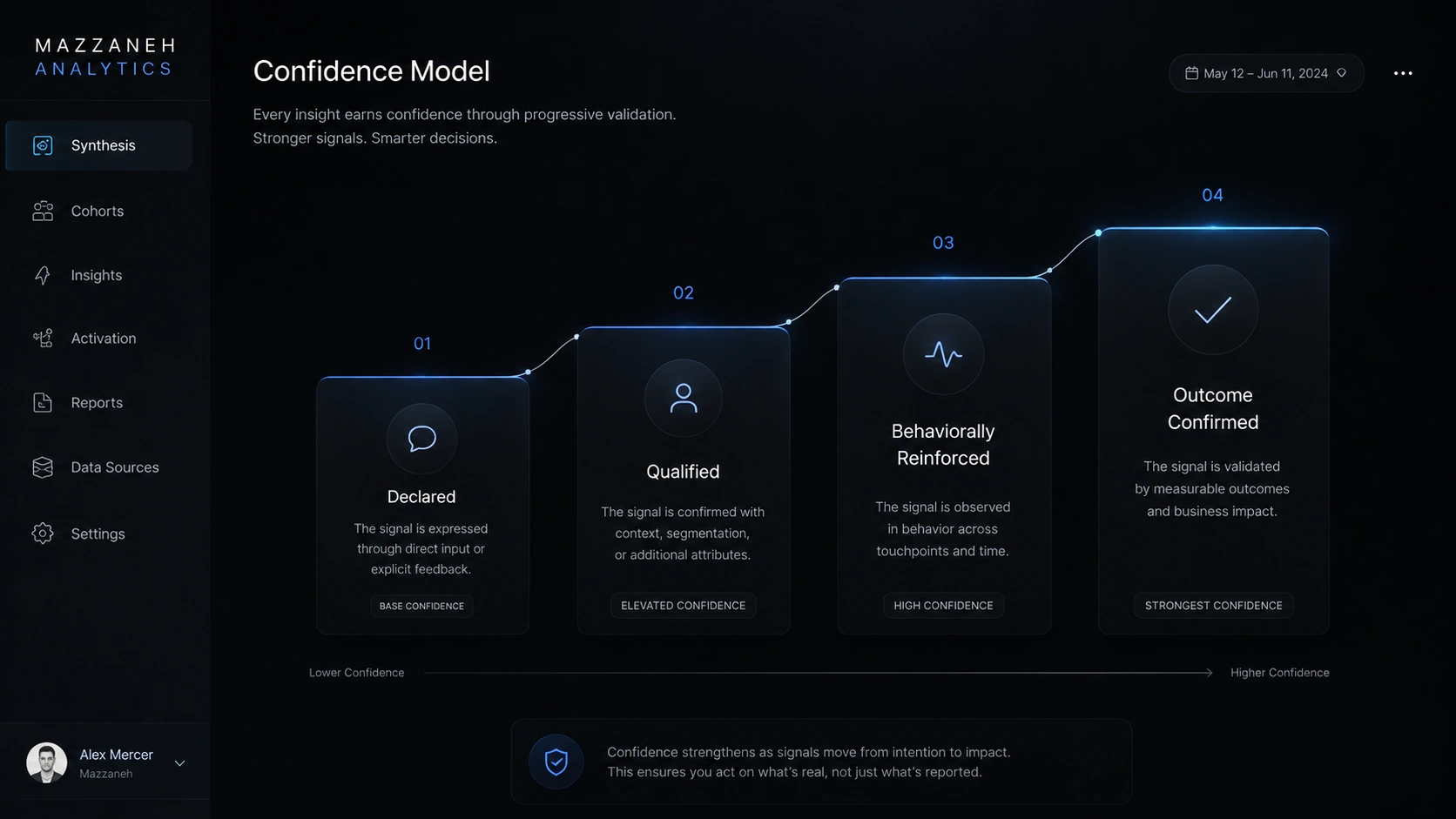
A context claim can begin as declared, become qualified, be reinforced by later behavior and gain stronger support when an outcome confirms it.
Declared
Base context provided explicitly by the user, useful but not independently reinforced.
Qualified
Higher-confidence context where an applicable eligibility or validation mechanism exists.
Reinforced
Later behavior begins to strengthen—or challenge—the original declaration.
Outcome-confirmed
Commerce or another measurable outcome can support the interpretation further.
Learning loop
The useful output is not the dashboard. It is the learning loop.
Analytics should be judged by the provenance and quality of the loop, not by visual polish alone.
Define the object
Start with the product, collection, category, campaign or demand pattern being analyzed.
Observe responses
Connect the applicable preference, participation, request and outcome signals.
Build a cohort
Apply a source-defined filter without presenting the threshold as an accuracy claim.
Inspect patterns
Look for shared characteristics, category relationships and contradictions.
Test a hypothesis
Translate the pattern into a campaign, merchandising or market decision that can be measured.
Legacy case method
Show the method without pretending the example is external validation.
The legacy Zara women's collection example is retained only as an illustrative case method: product set → preference analysis → higher-match cohort → shared characteristics → recommendation. It does not imply Zara was a verified client.
Commercial value
Better decision context—not ownership of the user.
Analytics helps businesses make more relevant decisions without reducing the person to a raw data asset.
Explain the cohort
Identify which characteristics, preferences or behaviors cluster around a product or category.
Improve relevance
Choose more appropriate cohorts for Board or Follow without claiming perfect targeting.
Read current need
Interpret request categories, urgency, local supply response and fulfilment friction.
Connect product and preference
Explore which attributes or categories align with structured preference clusters.
Find contradictions
See where actual behavior reinforces—or challenges—declared context.
Improve supply response
Identify demand patterns that are answered, delayed or ignored.
Governance
Consent-first is a design direction—not a substitute for compliance review.
Historical logic emphasized explicit participation and user value exchange instead of silent extraction. A modern rebuild still requires purpose limitation, data minimization, retention, deletion/correction rules, targeting governance and separate rights analysis for any future model training.
Product view · 01
Separate signals become a learning system.
Analytics is a synthesis node, not a master controller. It interprets relationships among current demand, local response, Board attention, Pulino context, preference and outcomes.
Product view · 02
Confidence should progress with evidence.
More data is not automatically better. More independent signal types can make an interpretation more defensible when their provenance remains visible.
What the page can establish
Mechanism first.
Performance requires evidence.
- Explicit preference and context collection as distinct signal types.
- A confidence architecture from declaration to outcome confirmation.
- A product/collection → cohort → pattern → recommendation learning method.
- Cross-module synthesis with contradictions preserved.
- Business-facing recommendations that remain testable rather than absolute.
Connected systemModule signals→Provenance→Confidence→Synthesis→Business learning
Claim boundary
The architecture is meaningful; performance and legality require evidence. This page does not claim 10× conversion, 80%+ accuracy, perfect targeting, absolute privacy compliance, competitor superiority or verified Zara client status. Exact schema, filters, models, live pipelines and measured lift remain evidence-routed.